 Logma
Short answer: for the calorie deficit itself, usually no. A GLP-1 like Ozempic, Wegovy, Mounjaro or Zepbound lowers how much you eat on its own, so you don't have to hit a daily calorie target to lose weight. The number worth watching instead is protein, because a real chunk of the weight you drop can come from muscle if you're not careful.
So tracking on a GLP-1 is a lighter job than classic calorie counting. You're not policing a budget. You're checking that you still eat enough, and enough protein, on the days you're barely hungry. Here is what the research shows and how to log it in a few seconds.
Quick disclosure: I'm Batu, and I build Logma, a voice calorie tracker for iPhone, so I'm biased. I'll tell you where a dedicated GLP-1 app fits you better than mine, and every number below comes from a source you can check at the bottom.
Why the drug does the calorie math for you
This is a mainstream question now, not a niche one. In a Gallup poll from mid 2026, 11 percent of US adults said they currently take a GLP-1, up from 3 percent in 2024, and 15 percent said they'd used one at some point. A lot of people are asking the same thing you are.
Here is why you can skip the daily calorie target. In a 60 week trial covered by Healthline, people on semaglutide ate 24 to 30 percent fewer calories than people on a placebo, measured at meals where they ate until they were comfortably full. They weren't counting. The drug cut their intake for them, and they lost about 15 percent of their body weight versus 3 percent in the placebo group.
Yale researchers recently found these drugs may work less by flat appetite suppression and more by triggering the body's own response to eating less, though that study was in mice, so take it as a direction, not a verdict. Either way, the practical point holds: the deficit is built in. Counting calories to force one on top of that is mostly busywork.
So what should you track instead? Protein
The catch with fast weight loss is where the weight comes from. According to Mayo Clinic, roughly 25 to 40 percent of the weight lost on a GLP-1 can come from lean mass, not just fat. Muscle is part of that, and muscle is the thing you want to keep.
Two things protect it: enough protein, and resistance training. Mayo recommends 1.2 to 1.6 grams of protein per kilogram of body weight a day while you're actively losing, well above the basic 0.8 g/kg. That is the number I'd put at the center of a GLP-1 log, not calories. Here is what the range looks like in pounds.
| Your weight | Protein target per day |
|---|---|
| 150 lb (68 kg) | 82 to 109 g |
| 180 lb (82 kg) | 98 to 131 g |
| 200 lb (91 kg) | 109 to 145 g |
| 250 lb (113 kg) | 136 to 181 g |
Protein alone won't do it. Mayo is clear that strength training is what tells your body to hold on to muscle, so the eating and the lifting go together. If you want the longer version on protein math, I wrote a whole guide to protein per kg.
When counting calories on a GLP-1 still helps
Skipping the daily target doesn't mean never looking at the numbers. A loose log earns its place in a few spots.
- You stall. If the scale has sat still for a few weeks, a short stretch of honest logging shows whether your intake crept back up, which happens as your body adjusts.
- You're eating too little. This is the quieter risk on a GLP-1. If a day's food adds up to 900 calories and 30 grams of protein, that's not discipline, that's a setup for losing muscle and feeling wrecked. A log is the only way you'd catch it.
- You're coming off the drug. Appetite comes back when you stop, sometimes fast. The people who hold their loss are usually the ones who switch to normal tracking before the hunger returns, not after. My calories to lose weight post has the math for a maintenance number.
So the honest answer is: you don't need to count every day, but you want the habit ready for the days it matters.
The real problem on a GLP-1 is logging when you're not hungry
Here's what actually trips people up. On a GLP-1 your meals get small and odd. A few bites of dinner, half a yogurt at 3pm, a protein shake because nothing else sounded good. That grazing pattern is miserable to log in a search and type app, where every item is a search, a scroll and a serving size. It's the kind of friction that makes you quit by week two.
This is where talking wins. You say what you had and it's logged, weird portions and all.
"Half a chicken breast, a few bites of rice and a spoon of hummus."
Logma counts every item in that sentence and logs the calories and macros, protein included, in about 3 seconds. Type it instead if you'd rather not talk, same result. There's no account to set up and your meals stay on your phone, which matters more than usual when the subject is a prescription. It works in English and Turkish, on iPhone with iOS 17 or later.
A simple way to track on a GLP-1
If I were starting this week on a GLP-1, here's the whole system.
- Make protein your main number, not calories. Use the table above for your target.
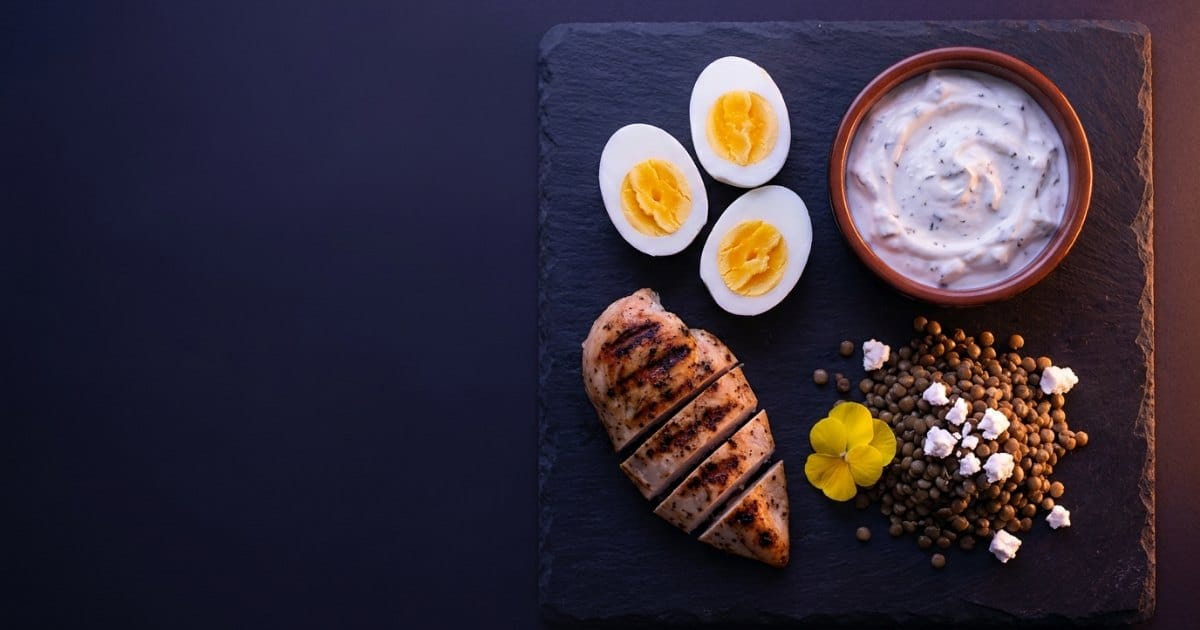
- Eat the protein first at every meal, while your appetite is still there. A few bites of chicken beat a few bites of bread.
- Log right after you eat, even the tiny meals. One sentence by voice or text. The small stuff is exactly what you forget by night.
- Weigh yourself weekly, not daily, and watch the trend. Day to day water swings mean nothing.
- Lift something twice a week. This is the part that keeps the muscle the protein is protecting.
You don't need to weigh every gram for this. Rough is fine when the goal is "did I get enough protein today", and I made the case for that in tracking without weighing your food. If you want a fresh maintenance or deficit number to sanity check against, the free calorie calculator takes a minute. Short on protein ideas, the high protein snacks list is built for exactly this.
Where a dedicated GLP-1 app fits better
To be fair about it: tracking food is only part of GLP-1 life. There are weekly injections to remember, doses that step up, and side effects like nausea worth keeping an eye on. If you want all of that in one place, a purpose built app beats a general tracker.
MyNetDiary, for example, launched a GLP-1 Companion that pairs injection reminders, protein tracking, digestive symptom logging and meal planning. If injection reminders and a symptom diary are what you're missing, that's a better fit than Logma, plainly.
Logma does one part of this well: it logs calories and macros fast by voice or text, with protein right there in the breakdown, no account, on iPhone. If the thing wearing you down is logging those small awkward meals, that's the part it's built for. The yearly plan starts with a 3 day free trial, then it's $49.99 a year. If you want to see how it stacks up against the field, my comparison of calorie tracking apps goes app by app.
FAQ
Do you need to count calories on Ozempic or Wegovy?
Not for the deficit. A GLP-1 lowers how much you eat on its own, so you lose weight without hitting a daily calorie target. It's worth tracking protein though, and worth a loose calorie log if you stall, if you suspect you're eating too little, or when you come off the drug and your appetite returns.
How much protein should I eat on a GLP-1?
Mayo Clinic recommends 1.2 to 1.6 grams of protein per kilogram of body weight a day while you're actively losing weight. For a 180 pound (82 kg) person that's about 98 to 131 grams a day. Pair it with resistance training, because protein alone won't keep muscle.
Why am I losing muscle on a GLP-1?
Because fast weight loss pulls from lean mass too, not only fat. Mayo Clinic says roughly 25 to 40 percent of the weight lost on a GLP-1 can come from lean mass. Enough protein and strength training are what shift that balance back toward losing fat.
Should I track calories after I stop taking a GLP-1?
Yes, that's the moment it matters most. Appetite returns when you stop, sometimes quickly, so building the tracking habit before you come off tends to be what holds the weight loss. Get a maintenance number from a calorie calculator and log normally.
What is the best calorie tracker for GLP-1 users?
It depends what you need. If you want injection reminders and a side effect diary alongside food, MyNetDiary's GLP-1 Companion is built for that. If the hard part is logging small irregular meals, Logma lets you say or type one sentence and logs the calories and macros, protein included, in about 3 seconds.
Does Logma track protein?
Yes. Logma logs calories and macros, so protein, carbs and fat all show in the breakdown. That makes it easy to use protein as your main number on a GLP-1 instead of calories.
Sources: Gallup, GLP-1 usage reaches new high (2026) · Healthline, Semaglutide sustains lower calorie intake over a year · Mayo Clinic, GLP-1 medications and muscle loss · Yale News, New study may change how we think about GLP-1s. Numbers are approximate and can change; nothing here is medical advice.